
Part 9 — Loving Noah Was Never the Difficult Part
The genetic testing confirmed what the doctors had already suspected.
Noah had Down syndrome.
The result did not change him.
He still hated diaper changes.
Still calmed almost instantly when Brandon held him against his chest.
Still made tiny squeaking sounds in his sleep that caused both of us to check whether he was awake.
We began learning.
Not everything at once.
One thing at a time.
Early-intervention programs.
Feeding support.
Cardiology appointments.
Developmental therapy.
Hearing checks.
Thyroid monitoring.
We learned what questions to ask.
We learned that internet searches done at two in the morning were rarely helpful.
We learned to listen to doctors without letting medical language swallow our entire child.
Most importantly, we learned how quickly people could reduce Noah to one fact about him.
Some reacted with pity.
Some tried to sound inspirational.
Some spoke as though our family had experienced a tragedy.
I stopped accepting any of it.
Noah wasn’t a tragedy.
He was a baby.
Our baby.
He needed care.
So did every child.
Some of his needs were different.
That did not make his life less valuable.
Brandon also changed the way he dealt with his mother.
No more secret conversations.
If Kimberly had concerns about Noah, she spoke to both of us.
If fear resurfaced, she had to call it fear—not wisdom, not realism, and certainly not advice.
Trust did not return because of one apology.
It rebuilt slowly.
Kimberly did the work.
She read better information.
She listened.
She stopped comparing Noah to Matthew.
Eventually, she began talking about finding out what had happened to the son she’d given up.
Not because she expected forgiveness from him.
Not because she assumed he would want a relationship.
But because she finally understood that avoiding the truth had shaped too much of her life already.
That part was hers to face.
Our responsibility was Noah.
Part 10 — There Was Still Time
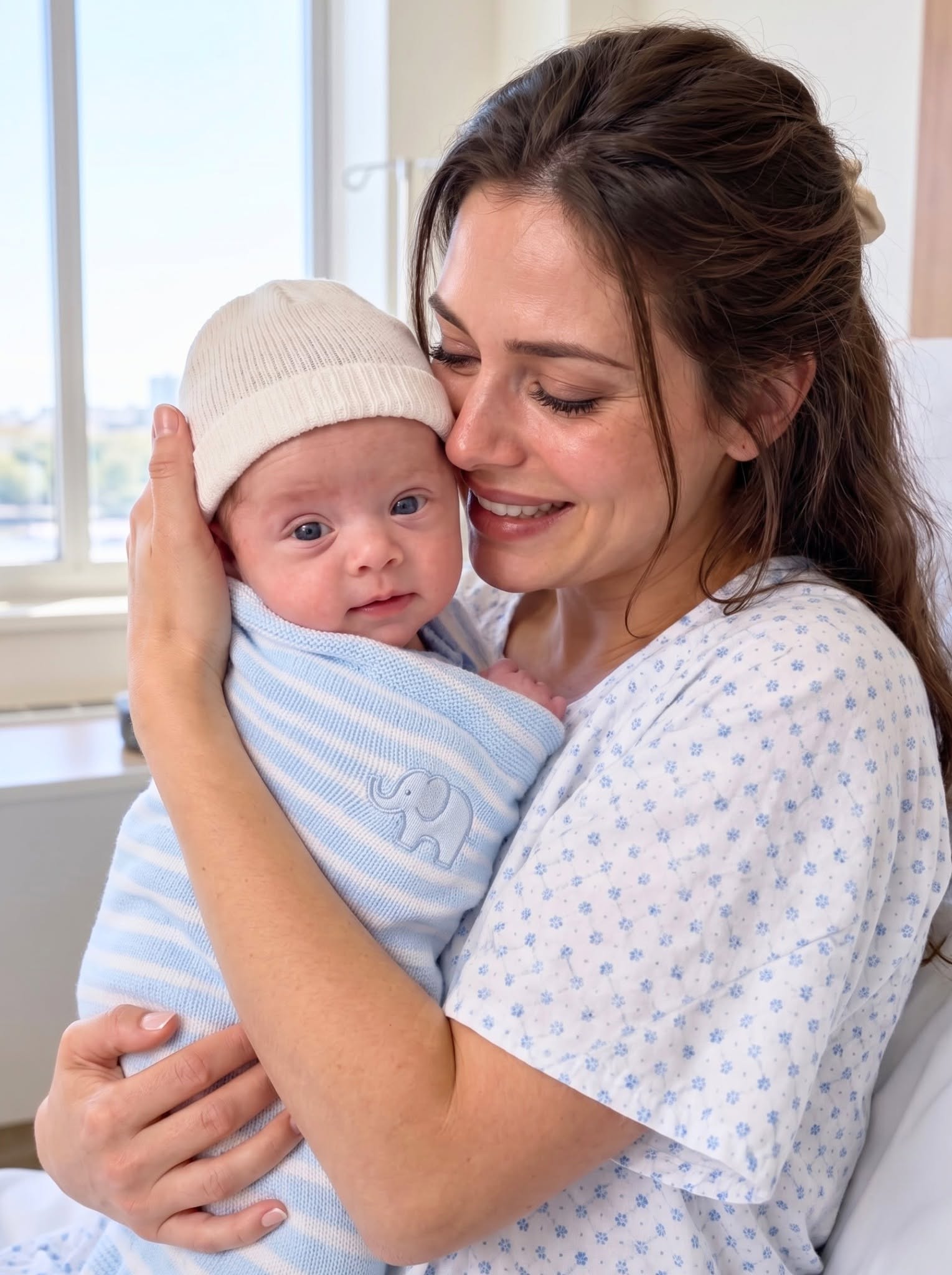
Noah is eight months old now.
He has Brandon’s smile.
He despises socks with a passion I didn’t know an infant could possess.
I put them on.
He removes them.
I put them back.
He looks me directly in the eye and removes them again.
He laughs every single time I sneeze.
Not smiles.
Laughs.
Apparently my allergies are the greatest comedy performance he has ever witnessed.
His heart defect is still being monitored, but so far his doctors are encouraged by how he’s doing.
There are appointments on our calendar that I never imagined five years ago.
There are words in my vocabulary I never expected to learn.
There are still moments when I worry about his future.
I’m his mother.
I suspect worrying about his future is now a permanent part of my own.
But fear no longer gets to define how I see him.
Sometimes, late at night, I remember that hospital hallway.
I remember standing behind the corner listening to Brandon say:
“You’re right, Mom.”
For those few seconds, I thought my marriage was ending.
I thought I was listening to the father of my child choose fear over his son.
Instead, I was hearing something completely different.
I was hearing Brandon refuse to inherit his mother’s regret.
Kimberly had spent decades carrying a decision she made while frightened, young, and surrounded by people who convinced her that disability automatically meant the end of an ordinary, meaningful life.
Then Noah was born.
And all the shame she had hidden came rushing back.
Her first instinct was to run from it again.
To convince Brandon to run too.
But he didn’t.
And eventually, neither did she.
Kimberly once told my husband:
“You still have time to leave him.”
For months afterward, I hated that sentence.
Now I hear it differently.
Because there was still time.
Not time to leave Noah.
Time to leave behind the fear that had been passed from one generation to another.
Time for Brandon to choose differently than his mother had.
Time for Kimberly to admit that regret had been controlling her for thirty years.
Time for me to stop imagining that uncertainty meant disaster.
Time for all of us to understand that a diagnosis is information about a person.
It is not the measure of that person’s worth.
And above all, there was time to choose our son.
Not the imaginary child we had pictured during five years of infertility treatments.
Not the future we had constructed before he was born.
Noah.
Exactly as he was.
The little boy we had cried for.
Waited for.
Prayed for.
And finally held in our arms.
We had spent five years asking for a child.
When he finally came to us, life asked a different question:
Could we love the child we were given instead of the future we had imagined?
For Brandon and me, there was only one answer.
We already did.